
Why Data Governance Matters
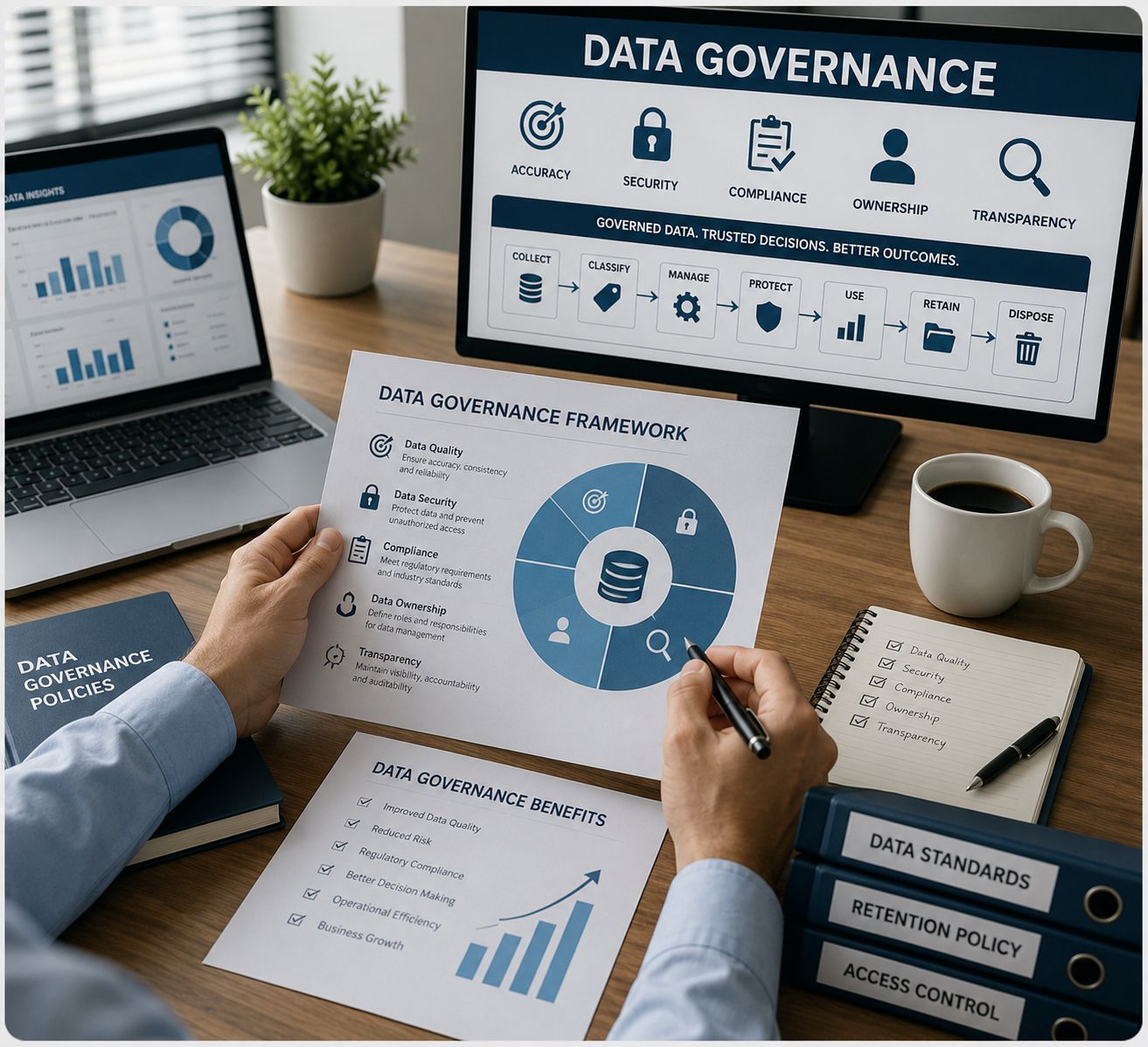
Every business relies on data to make decisions, maintain compliance, improve efficiency, and support growth. Yet many organizations continue to struggle with inconsistent records, duplicate information, poor visibility, and increasing regulatory expectations. As data volumes continue to grow, managing information effectively is no longer just an IT responsibility. It has become a business priority. Organizations that cannot trust their data often face operational inefficiencies, compliance challenges, and poor decision- making. This is where data governance becomes essential.
Data governance is the framework of policies, processes, standards, and responsibilities
that ensure data is accurate, secure, consistent, and properly managed throughout its
lifecycle. It defines who owns the data, who can access it, how it is used, and how it is
maintained.
Simply put, data governance helps organizations trust their data.
Strong governance delivers real, measurable benefits. Here's what organizations gain when they invest in it.
Poor-quality data leads to poor decisions. Duplicate records, outdated information, and
inconsistent definitions can create confusion across departments and business functions.
Effective governance establishes standards that improve data accuracy, completeness, and
reliability. When decision-makers have confidence in their data, they can act faster and
with greater certainty.
Organizations today face increasing regulatory obligations related to data privacy,
security, retention, and reporting. Regulations such as GDPR, HIPAA, SOX, and industry-
specific requirements demand greater accountability over how information is managed.
A strong governance framework helps businesses demonstrate compliance by ensuring
records are properly controlled, accessible, and auditable.
Without governance, critical information can be lost, duplicated, misplaced, or accessed by
unauthorized individuals. These issues increase both operational and legal risks.
Data governance introduces clear controls, permissions, and accountability structures
that reduce the likelihood of costly errors, security incidents, and compliance failures.
Executives rely on data to guide strategic decisions. When information comes from
multiple systems with conflicting results, confidence declines.
Governance helps establish a single source of truth by standardizing data definitions and
ensuring consistency across the organization. This allows leaders to make informed
decisions based on trusted information.
Not every employee should have access to every piece of information. Data governance
helps define roles, permissions, and access policies that protect sensitive information
while ensuring authorized users can quickly retrieve what they need.
This balance between accessibility and security is critical for modern organizations.
AI, analytics, automation, and digital transformation initiatives all depend on reliable data.
Even the most advanced technologies cannot deliver meaningful outcomes when the
underlying information is inaccurate, duplicated, or poorly managed.
Data governance provides the foundation needed for successful digital initiatives by
ensuring data remains structured, reliable, and accessible.
Organizations without effective governance often experience:
* Inconsistent reporting
* Compliance violations
* Increased audit findings
* Higher operational costs
* Lost productivity searching for information
* Reduced trust in business intelligence and analytics
Over time, these challenges can significantly impact both profitability and reputation.
What begins as a data management issue can quickly evolve into a business risk.
Data governance is not solely a technology initiative. It requires collaboration between
business leaders, compliance teams, IT departments, and end users.
Successful organizations establish clear ownership, define standards, implement policies,
and create accountability for managing information effectively. When governance
becomes part of everyday operations, data transforms from a liability into a strategic
asset.
As organizations strengthen governance practices, having the right systems to manage,
secure, retrieve, and control information becomes increasingly important. Technology
plays a key role in helping businesses maintain visibility, accountability, and compliance
across their information landscape.
So where does this leave your organization?
Data governance is no longer optional. As organizations generate and manage increasing
volumes of information, the need for accuracy, security, compliance, and transparency
continues to grow.
Businesses that invest in strong data governance frameworks are better positioned to
reduce risk, improve decision-making, support regulatory requirements, and unlock the
full value of their data.
The question is no longer whether organizations need data governance.
The question is whether they can afford to operate without it.
Sudeesh is a seasoned Technology Business Leader with 30 years of experience in software product management and enterprise leadership. Over 23 years at SAP, he led development teams, managed products across SAP’s portfolio, and drove adoption of SAP technologies across APAC region, delivering solutions used in over 40 countries
Govind Gagoria is a seasoned finance professional with over 20 years of experience in leadership roles across industries such as manufacturing, commodities trading, and power in APAC.
In 2017, he founded Auggit with a vision of simplify audits and document management, addressing industry pain points he experienced firsthand. Auggit has evolved into a global company, simplifying data, document, and compliance management with innovative solutions

